“Who am I?” Can you teach children philosophy?
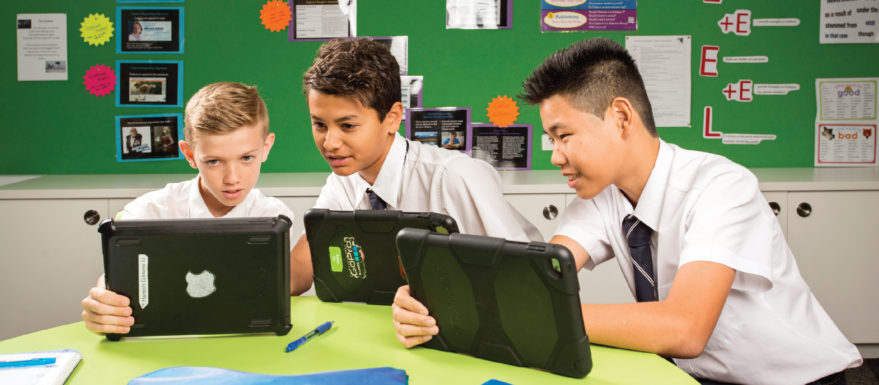
In 2018 The Cathedral School will roll out its newly developed Philosophical Inquiry class to its four Year 7 classes. The goal of the program is to develop the students’ critical thinking, scientific reasoning and emotional intelligence, which are key to succeeding in school and the life beyond.
At first thought, teaching philosophical thinking to a classroom of 12 year olds may seem complex and too far reaching, too abstract – they’re just kids! Surely they’d rather be chasing Pokemon. In reality, even very young children can be taught philosophical thinking, and probably should be.
A UK-study released in 2015 looked at 3,159 primary school students from 48 schools, over one year, and found significant improvement across the board in maths, reading and writing, as well as confidence, patience and self-esteem. The study found that students who undertook philosophy classes progressed months ahead (in maths, four months ahead!) compared to those who didn’t.
The Cathedral School’s Director of Teaching and Learning – Middle School, Leonie Butler has seen the results other Australian schools are yielding through philosophical programs and has minted a new class titled Philosophical Inquiry, which will roll out to the school’s 2018 Year 7 students.
“There is plenty of educational research demonstrating that Philosophical Inquiry has the capacity to significantly enhance student learning,” says Leonie.
“At the age of 12 most students are beginning to work within the Formal Operational stage of cognitive development as coined by developmental psychologist Jean Piaget, and are capable of logical thought with the capacity to develop abstract thinking skills,” says Leonie of the decision to implement the program to Year 7, the students’ entry into Middle School.
“The program aims to provide the students with life skills that are entirely transferrable to them as individuals in a complex society. One aim is to help students develop the capacity to avoid ‘jumping to conclusions’; instead providing them with a skill set that they can use to carefully consider all available information and come to well-reasoned decisions.
“Whilst some content matter within the discipline of Philosophy will be taught, the subject is predominately about the philosophical process. It is about teaching students to apply logical deductive and inductive reasoning skills; teaching students to recognise generalisations and identify flawed arguments.”
“The capacity to regulate one’s emotional responses is a crucial life-skill when considering success in the future workforce.”
– Leonie Butler
Leonie expects the program will accelerate the development of rational and well-reasoned thought processes, as well as metacognitive thinking processes, and build students’ capacities to collaborate, group problem-solve, actively listen and engage in sustained, persistent, deep thinking, often in spite of an apparent lack of answers.
“Certainly any form of philosophical questioning is very likely to help to provide students with a wider world view,” says Leonie. “The capacity to see a bigger picture and to recognise complexity in any issue also allows for the development of respect for others’ opinions and perspectives.
“A second aim of the program is the development of emotional intelligence and self-regulation strategies,” Leonie continues. “The capacity to regulate one’s emotional responses is a crucial life-skill when considering success in the future workforce. Research shows a link between job performance and high emotional intelligence, particularly when it comes to leadership. Of course, many of today’s students will be the leaders of the future.”
Importantly, with students experiencing a world of expectations and social pressure, Leonie says these skills can be applied to thinking about themselves and engaging in deep and sustained personal reflective thinking to help them see the big picture.
Ultimately, this program is about teaching students to think for themselves, to really think for themselves and apply a broader view instead of a reactive thought response.
The program will extend through Middle School and into the Senior School as the 2018 Year 7 cohort progresses.
“It is our belief as a school that this program will challenge our students and will support them to develop the skillset they need to be highly successful individuals.”
To enquire about The Cathedral School 2018 enrolments, visit cathedral.qld.edu.au.